Research note 02
Detecting Sprint Asymmetry From IMU Data
A single trunk-mounted inertial unit can say useful things about left-right differences in running — and a great deal that it cannot. Separating the two matters most in exactly the situation where the temptation is strongest: a return-to-play decision.
The question arrives in almost every return-to-play conversation. The athlete has completed the progression, looks fine to the eye, and someone wants to know whether the injured side is still doing less work than the other one. Since every athlete is already wearing an inertial pod, the natural follow-up is: can the pod tell us?
Partly. The honest version of the answer is more interesting than either “yes” or “no”, and it depends heavily on what you mean by asymmetry.
What a trunk-mounted IMU actually sees
Our pod sits between the scapulae, roughly over the upper thoracic spine, sampling acceleration and angular velocity at up to 1000 Hz. During running it sees the trunk's response to each foot-strike: a vertical acceleration spike at contact, a characteristic anteroposterior pattern through stance, and mediolateral oscillation driven by the alternating single-support phases.
From that signal we can segment individual steps with high reliability, assign each step to a side, and derive per-step timing and magnitude features. Step segmentation from a trunk sensor is a well-established technique and it works: at 1000 Hz, contact events are resolvable to within a couple of milliseconds in clean data.
The features that survive scrutiny
Three families of feature hold up in our validation work against instrumented treadmill and force-plate reference data:
| Feature | Reliability | Caveat |
|---|---|---|
| Contact and flight time per side | Good | Degrades below about 3.5 m/s and on soft surfaces |
| Peak resultant acceleration at contact | Good | Very sensitive to harness tightness and pod placement |
| Step frequency and step-time variability | Good | Reliable across speeds; the most robust of the three |
| Vertical stiffness estimate | Moderate | Modelled, not measured; treat as an index, not a physical quantity |
| Per-limb force or impulse | Poor | Not derivable from a single trunk sensor; we do not report it |
That last row is the important one. A trunk sensor observes the summed, filtered consequence of what both limbs did, transmitted through a deformable body. Claims of per-limb ground reaction force from one torso-mounted device should be treated as modelled estimates with individual error large enough to swamp the asymmetries clinicians care about.
Speed is a confounder, not a nuisance
Asymmetry indices are speed-dependent. The same athlete measured at 4 m/s and at 7 m/s will produce different asymmetry values, and the difference is real mechanics rather than measurement error — limb behaviour genuinely changes as running velocity increases toward maximal.
This means an asymmetry number computed across a whole session is close to uninterpretable, because it averages over whatever speed distribution that session happened to contain. A session with more high-speed running will look different from one without, and the difference will be attributed to the athlete.
Our pipeline therefore computes asymmetry only within matched speed bands, requires a minimum step count per band before reporting anything, and refuses to produce a session-level asymmetry figure at all. Clients occasionally find that frustrating. It is deliberate.
How big a difference means anything?
Here is where practitioners are most often misled. Symmetry is not the healthy default. Uninjured athletes routinely show consistent left-right differences of several percent in contact time and rather more in impact magnitude, arising from limb dominance, prior history and simple anatomical variation. A ten percent asymmetry index means nothing without knowing what that athlete's index was before.
The measurement also has its own noise floor. Between-session variability in our contact-time asymmetry index, for the same athlete at the same speed band with a correctly refitted harness, is on the order of a few percentage points. An observed change smaller than that noise floor is not a finding.
This is why the only defensible use is longitudinal and individual: this athlete's asymmetry index in the 5–6 m/s band, tracked across a rehabilitation progression, compared to their own pre-injury value in the same band. A trajectory returning toward baseline is meaningful evidence. A single number compared against a population threshold is not.
What ruins the data
- A loose harness. The single largest error source. Pod translation relative to the trunk during high accelerations produces artefact indistinguishable from signal.
- A rotated pod. Static mounting rotation can be detected and corrected; a pod that shifts mid-session cannot.
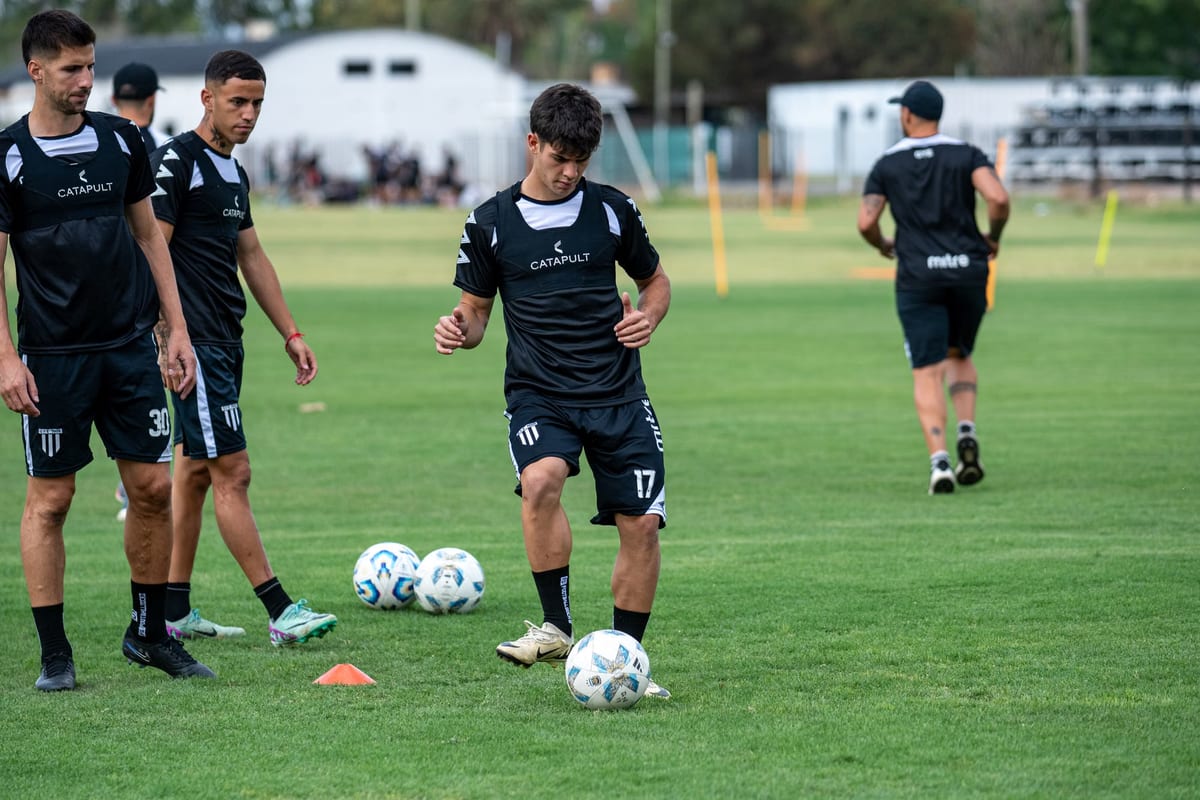
- Surface change. Grass, artificial turf and an indoor court produce different impact signatures. Do not compare across them.
- Footwear change. A change of boot or the addition of an orthotic invalidates the comparison until a new baseline exists.
- Low step counts. Asymmetry estimated from a handful of steps in a band is dominated by sampling noise.
More detail on the first two is in Why Sensor Placement Decides Your Data Quality.
Using it in a return-to-play decision
Our position: IMU-derived asymmetry is a legitimate supporting input to a return-to-play conversation, and an illegitimate sole criterion. It is one strand alongside clinical assessment, strength testing, the athlete's own report and, where available, markerless kinematics. It is at its most valuable when it disagrees with the other strands, because that disagreement is worth investigating.
What it should never be is the number that clears an athlete. The measurement is good enough to inform a clinician and not good enough to replace one, and a product that blurs that line does the athlete no favours.