
Training Load & Readiness
External and internal load in one model, with RMSSD-based readiness and honest uncertainty bands.
Module detail — Training Load & ReadinessModule 01 · Wearable Telemetry
A 12 g pod worn between the scapulae that records inertial, positional and cardiac data for a full training week, and hands it over in formats other people can read.
The TSA‑P4 carries a nine-axis inertial platform: a tri-axial accelerometer with a ±32 g range, a gyroscope to ±4000 °/s and a magnetometer for heading. Those three are fused on-device using a complementary filter that runs at the configured sample rate, producing an orientation estimate alongside the raw streams. We log the raw streams as well as the fused output, deliberately: any orientation filter makes assumptions, and if you disagree with ours you should be able to re-derive orientation yourself from what the sensor actually saw.
Positioning is dual-source. Outdoors the pod runs a dual-frequency GNSS receiver on L1 and L5, tracking GPS, Galileo, GLONASS and BeiDou, at a 10 Hz solution rate. The second frequency matters more than the constellation count: L5 lets the receiver estimate and remove most of the ionospheric delay, which is the largest single error term in a single-frequency consumer receiver. Indoors the pod falls back to an ultra-wideband local positioning system at 20 Hz, using fixed anchors surveyed into the venue. Every position sample is tagged with its source, so a distance total never silently mixes two positioning regimes.
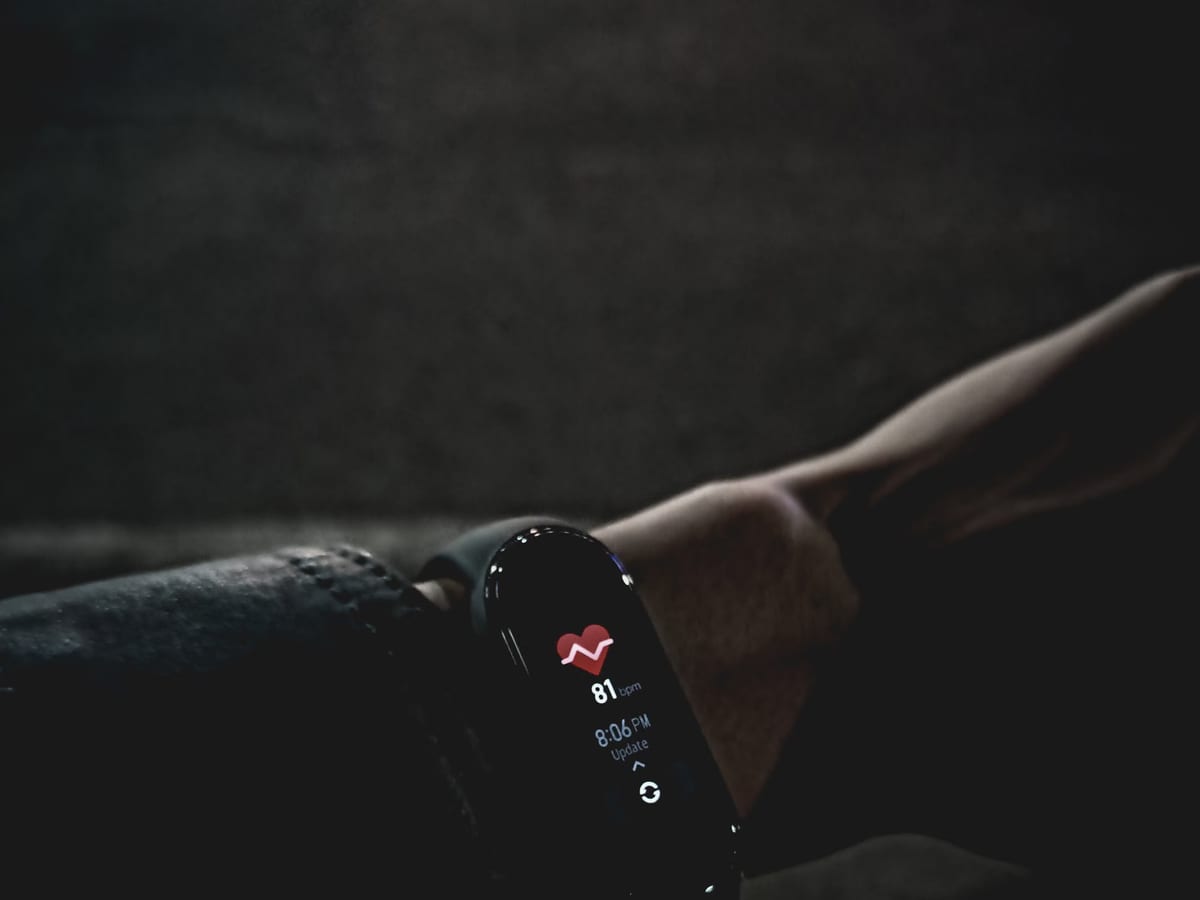
Cardiac data arrives over Bluetooth Low Energy from a chest strap or optical arm band. We record RR intervals, not just an averaged heart rate, because every heart-rate-variability metric worth computing needs beat-to-beat timing. An averaged BPM value discards exactly the information RMSSD depends on.
Higher is not automatically better. At 1000 Hz you capture the true acceleration peak of a foot-strike or a landing; at 100 Hz you capture a smoothed envelope that will systematically under-report those peaks. But 1000 Hz costs battery, storage and offload time, and for a session where the question is “how much high-speed running did this athlete do” it buys you nothing at all.
Our default recommendation for a team-sport senior squad is 250 Hz, moving to 1000 Hz for specific testing blocks and for any athlete inside a return-to-play progression where landing mechanics are part of the decision. The pod supports switching per session, and the workspace records which rate produced each metric so you never compare a 100 Hz peak against a 1000 Hz one.
The largest error source in body-worn inertial measurement is not the sensor. It is the soft tissue and fabric between the sensor and the skeleton. A loose harness lets the pod translate relative to the trunk during high accelerations, adding an artefact that looks exactly like real signal. A pod rotated 15° from its intended orientation contaminates every axis-specific metric you derive from it.
So the harness matters as much as the electronics. Ours ships in seven sizes with an elasticated scapular pocket that holds the pod flat against the upper back, and a fitting protocol your staff run once per athlete and re-check at pre-season. The pod's magnetometer plus a short standing calibration lets the pipeline detect and correct a static mounting rotation, but nothing corrects a harness that moves.
A single trunk-mounted pod cannot measure joint angles, cannot measure ground reaction force, and cannot tell you what an individual limb did. Metrics that claim otherwise from one sensor are modelled estimates with wide individual error. For joint kinematics use markerless motion capture; for ground reaction force, use a force plate and let us ingest the result.
Pods dock in a 20-bay charging case that charges and offloads simultaneously over the venue's Ethernet or Wi-Fi. A full training week captured at 250 Hz takes roughly four minutes per pod to transfer, so a 25-player squad clears in the time it takes to run a debrief. Offload is resumable; an interrupted transfer picks up rather than restarting.
Once uploaded, sessions are available as summarised CSV, as FIT for tooling built around the ANT+ ecosystem, as JSON through the REST API, and as compressed raw binary with a published, version-pinned schema. The raw format is genuinely raw: the sensor counts, the calibration coefficients and the timestamps, with nothing removed. Sports-science groups who want to run their own pipeline get everything they need without asking us for a special export.
Rated IP67, so dust-tight and survivable at one metre of immersion for thirty minutes — rain, mud and a dropped pod in a puddle are fine, a pressure washer is not. The operating range runs from −10 °C to +50 °C, with thermal throttling that reduces maximum sample rate above 45 °C rather than shutting the pod down mid-session. Battery is a sealed lithium-polymer cell rated for around 500 full cycles before capacity falls below 80 percent, which for a squad training six days a week works out at roughly two to three seasons. We replace cells as a serviceable item rather than treating a tired battery as a dead pod.
Elsewhere on the chain
External and internal load in one model, with RMSSD-based readiness and honest uncertainty bands.
Module detail — Training Load & Readiness
Multi-camera pose estimation for joint kinematics without suits, markers or a laboratory booking.
Module detail — Markerless Motion Capture
Survival models over exposure history that surface changing risk profiles instead of a single traffic light.
Module detail — Injury Risk ModellingForty-five minutes, one anonymised session file, and a straight answer about whether this module solves the problem you actually have.